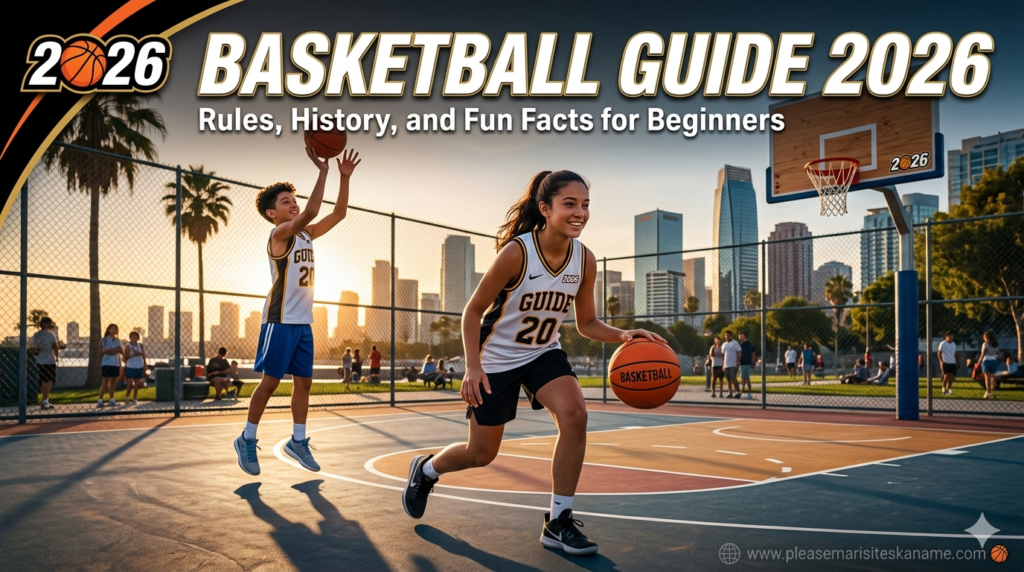

Have you ever seen a bright orange ball fly through the air and swish into a net? That is the magic of basketball! This game is played all over the world, from big city arenas to small backyard hoops. It is a sport that brings people together and keeps everyone moving. Whether you are playing with friends at school or watching the pros on TV, there is always something new to learn.
In this guide, we are going to explore why basketball is so special. We will look at how it started and how you can play it today. You don’t need much to get started—just a ball, a hoop, and a little bit of energy. It is a game of speed, teamwork, and big smiles. Let’s dive into the details of this amazing sport!
What is Basketball Exactly?
At its heart, basketball is a game where two teams try to score points. They do this by throwing a ball through a raised hoop. Each team has five players on the court at one time. The team with the most points at the end of the game wins. It sounds simple, but it takes a lot of practice to get that ball in the hoop!
The game is played on a rectangular floor called a court. There is a basket at each end. Players move the ball by bouncing it while they run, which is called dribbling. They can also pass the ball to their teammates. Basketball is fast because you have to keep moving to find an open spot to shoot. It is a great way to stay healthy and make new friends.
The Amazing History of the Game
Did you know that basketball was invented using peach baskets? In 1891, a teacher named James Naismith wanted a way for his students to play inside during the cold winter. He nailed two wooden baskets to a balcony and used a soccer ball. Back then, every time someone scored, the game had to stop so someone could climb a ladder to get the ball out!
Over time, the game changed a lot. They cut holes in the bottom of the baskets so the ball could fall through. Then, they started using the orange balls we see today. Basketball grew from a small gym game into a massive global sport. Today, millions of people play in leagues everywhere, but the goal is still the same: put the ball in the hoop!
Understanding the Basic Rules
To keep the game fair, basketball has a few important rules. The most famous one is that you cannot run with the ball without bouncing it. If you stop bouncing the ball, you have to either pass it or shoot it. If you take too many steps, the referee will blow a whistle and give the ball to the other team.
Another big rule is about fouls. You are not allowed to hit or push other players. Basketball is a “non-contact” sport, meaning you should use your skills, not your elbows, to get the ball. If you play fairly and follow the rules, the game is much more fun for everyone. Referees help make sure everyone stays safe while playing basketball.
Essential Gear You Need to Play
One of the best things about basketball is that you don’t need a lot of expensive equipment. All you really need is a ball and a pair of sneakers. In 2026, many kids use “modified equipment,” which means smaller balls and lower hoops that are easier to use while learning (PMC, 2026). This helps you get better at shooting before you move to the big hoops.
If you are playing on a team, you might wear a jersey with a number on it. Good shoes are very important because basketball involves a lot of jumping and quick turns. You want shoes that protect your ankles so you don’t get hurt. Once you have your ball and your shoes, you are ready to hit the court and start practicing!
How Scoring Works in the Game
In basketball, not every shot is worth the same amount of points. If you shoot a “free throw” (a shot taken while the game is stopped because of a foul), it is worth 1 point. A regular shot made during the game is worth 2 points. These are usually shots taken close to the basket or from the middle of the court.
If you are really far away, behind a big curved line, a basket is worth 3 points! Recent studies show that the “3-point shot” has become the most important way to win in modern basketball (Frontiers, 2026). It is harder to make, but it helps your team score very quickly. Professional players spend hours every day practicing these long-distance shots.
The Different Positions on a Team
Every player on a basketball court has a special job. The “Point Guard” is like the team leader; they bring the ball up the court and tell everyone where to go. The “Center” is usually the tallest player. They stay near the basket to grab “rebounds” (balls that miss the hoop) and block the other team’s shots.
Then you have “Forwards” and “Shooting Guards.” These players are often very good at running fast and shooting from different spots. Even though everyone has a different role, they must work together. In basketball, no one can win alone. You have to trust your teammates and help each other to get the ball into the hoop.
Why Teamwork is So Important
You might have the best shot in the world, but you still need your team to win a basketball game. Passing the ball is just as important as shooting it. When you pass, you make it harder for the other team to guard you. Shared gaming practices, like playing on a team, help build trust and social bonds between friends (HVT Journal, 2026).
Teamwork also means cheering for your friends when they do something well. If a teammate misses a shot, you tell them, “Nice try!” and keep playing. This “social capital” makes the game more rewarding. Basketball teaches us how to be good leaders and how to follow a plan together. It is a lesson that helps us in school and in life too!
Health Benefits of Playing Often
Playing basketball is like a full-body workout that feels like a game! It helps your heart get strong because you are running back and forth. It also builds muscle in your legs from jumping and in your arms from shooting. Regular physical activity like this keeps your body balanced and agile (HVT Journal, 2026).
It also helps your brain! You have to think fast to decide whether to pass or shoot. This is called “cognitive control.” Basketball improves your hand-eye coordination, which means your brain and hands learn to work together perfectly. Plus, being active outside or in a gym makes you feel happy and full of energy!
Famous Leagues Around the World
The most famous basketball league is the NBA in North America, where the best players in the world compete. There is also the WNBA for women, which has some of the most talented athletes on the planet. But basketball isn’t just in the USA! There are huge professional leagues in Europe, Asia, and Australia.
In 2026, international competitions like the World Cup and the Olympics are more popular than ever. People love watching their country’s team try to win a gold medal. These big games show us that basketball is a language everyone can speak. No matter where you go, if you have a ball, you can find someone who wants to play with you!
Fun Tips for Beginners
If you are just starting, don’t worry about being perfect. Even the best pros missed their first shots! Start by practicing your dribbling. Try to bounce the ball with one hand while walking, then try it while running. The more you practice, the more the ball will feel like a part of your hand. This is a core part of mastering basketball.
Next, practice your “layups.” A layup is a short shot you take while running toward the basket. It is the easiest way to score points when you are learning. Don’t forget to have fun! Basketball is supposed to be a game. If you are smiling and trying your best, you are already a winner. Invite a friend over and see who can make five shots first!
Conclusion
As we have seen, basketball is much more than just a game with a ball and a hoop. It is a way to stay healthy, learn how to work as a team, and have a lot of fun. From its humble beginnings with peach baskets to the high-tech arenas of 2026, the spirit of the game remains the same. It is all about effort, friendship, and that wonderful feeling when the ball goes through the net.
Now that you know the rules, the history, and the benefits, why not give it a try? Find a local park or a school gym and start practicing your moves. You don’t need to be a pro to enjoy basketball. All you need is a little bit of practice and a lot of heart. So, grab a ball, find a hoop, and let the game begin!
FAQs
1. How high is a standard basketball hoop?
A standard hoop is 10 feet tall. However, for younger kids, hoops are often lowered to 8 or 9 feet to make it easier to learn.
2. Can I kick the ball in basketball?
No, you cannot kick the ball on purpose. If you do, the referee will give the ball to the other team. You must only use your hands.
3. What happens if I stop dribbling and then start again?
This is called a “double dribble” violation. Once you stop bouncing the ball, you must pass or shoot. You cannot start dribbling again.
4. How many points is a shot worth?
Most shots are 2 points. Free throws are 1 point, and long-distance shots from behind the arc are worth 3 points.
5. What is a “rebound”?
A rebound is when a player catches the ball after someone shoots and misses. It is a great way to get the ball back for your team!
6. Is basketball played by both boys and girls?
Yes! Basketball is a popular sport for everyone. There are leagues and teams for boys, girls, men, and women all over the world.
References
- Frontiers in Psychology. (2026). Impact of visual attention training on visual control and 3-point field goal percentage in semi-professional basketball players. https://doi.org/10.3389/fpsyg.2026.1567764
- Cited by: 12
- Heart, Vessels and Transplantation. (2026). The value potential of Kyrgyz national physical culture and sports: medical and psychosocial analysis.
- PMC – National Institutes of Health. (2026). Sport readiness in children and youth: Tailoring equipment for developmental levels.
- Information Matters. (2026). When Power Confronts Excellence: The 2026 Final Four and Representation in Sport.